Showing posts with label architecture. Show all posts

Sunday, 12 September 2021

Homeland


What countries ask of kings,

is rarely all the same,

re-population never to yours, the aim, of

any of those wild foreign games. In fact,

she wasn't sure 

she was unselfish enough

to plant seeds and tend, in any fresh plough.

Well now,

you supposed at her desires,

without any consultation as to what really

lit fires, and beacons, on her cliffs

and throne 

what it was that trully made you feel 

like home. Really she asked only,

that you stayed;

through her mists and temperate storms

that passed

just as eagerly as you wiggled your toes 

in her fresh spring grasses,

and moth-kissed her skin

on a summer's night.


You see, other countries 

might have demanded 

sight

of their future selves,

and a tiny crown,

in your eyes; but she;

was an island - 

an endless vacation,

yours to own, a tiny nation (of two),

for only the price 

of a heart,

and the holding of an equal hand; 

given over;

as a passport, a devoted citizen

of she,

your chosen homeland.   

Monday, 28 January 2019

The Passion

    
Here's a long story,
a glorious rapture descending - 
vines creeping, into veins and blood,
foliate bosses and hood-moulds 
crenellating,
the doors to Narnia's portal. They left my finger
hopelessly trailing,
over,
time
immortal. The long shadow of a broken sceptre,
ground beneath:
the bone collector, shaft of dust,
through long windows thrown
lighting wildflowers impossibly grown from the
ruins of matins,
prime and nones, 
a mystery extant speaks of all
that is gone in the wind,
the rain:
in the unholy fires,
the crashing down of celestories and 
spires, and I wandered amongst them; their gritty texture,
whispering of lauds,
compline and vespers, a scratch in
the buttress, striking the time: eyes to heaven and glitter
falls down my spine, still, and the doves that call,
from the remnant of a crossing,
emboss my heart and spread wings in my chest - 
where once the vestments 
were plain,
I see a myriad of colours overlain:
as a pale hand in a silken glove.
And it was here, I recall, my head began to spin with it.
It was here
I fell 
in love. 
  

Friday, 4 January 2013

Wet Dawn Over Coniston


A thousand panes and a hundred
eyes; challenge swirling mist and the
morning’s, grey sky, the water’s edge is a
precipice denied, and he teeters,
to tease of old times.
      
Stretching columns,
like a temple of sorts, belch out fresh spirits
that seem
to purport to the hills, and the mountainous
terrain, that he has withstood
far heavier rains than these sapphires,
that tumble and roll; worse gales than
this bluster that mal-forms and
folds all the trees, like green match-sticks
or grain,
as a forest slides on clouds
to meet him again.
      
Slowly, and with effort,
he creeks to his feet;
polite old gent who still stands
to greet and shake hands with his welcome guests;
shoes shone and tie on,
in his Sunday, church-best; the thousand eyes glint
and his pipes puff to test, if he still
can blow smoke rings
to delight all those present.
    
The ghost of a moon
forms a small-smiling crescent; overhead;
as he nods, and tilts his slate cap –
still as defiant and cheeky old chap, despite all his
crumbling walls…
    
The lake-fog rolls over to blanket his armchair.
    
Be seated –
I will walk to you,
weary Coniston Hall. 


Sunday, 20 June 2010

Rievaulx

         
Good day, old friend, it's been
some time,
but like one
gone
almost blind, I feel I am home;
for your stones have owned, moments,
of my
prolific life
without question or promise
of warm
safe nights or moral comfort...

...and I have always known,
your walls
had eyes.

You remind me now
as I sit on your carvings
of basest cravings long fulfilled;
you recall heaven
spilled in sunshine, on stone,
and things and hands long since cast from
my bones, and as I
trace my fingers on your
crumbling face
my own reddens for a lack
of restraint, in what was once,
holy space,
and I lick my lips and mouth
that name
and remember how we sullied
your tunneled drains.

Our backs to your sand, as the
swallows
flew over,
surrounded by moss and daisies
and clover, with filthy water
at our feet...
I see,
only now,
 - the first time I have been here since -
that as beautiful
as we thought
our act of defiance,
and freedom,
to be,
our supposed, sublime serenity
(and imposition)
was nothing here -
for it could not compete
with thee.
   
      
Written on a Leeds Savage Club Sketchers' Excursion to the stunning ruins of Rievaulx Abbey, North Yorkshire...

Monday, 15 February 2010

Medieval Architecture in my Glorious County - St. Hilda's Curves...

  
This is St. Hilda's, in Whitby, North Yorkshire.


First founded in 657AD, this glorious Benedictine abbey was the venue for King Oswiu of Northumbria's 7th century 'Synod of Whitby', wherein it was decided that the Northumbrian church would adopt the Roman Catholic calculation of Easter and monastic tonsure (the traditional monks' haircut!). It was also home to the Saxon poet, Caedmon.

The abbey was re-founded in 1078 on the orders of William de Percy, and re-dedicated to St. Peter and St. Hilda. It survived until 1540, when it was finally sacked during the Dissolution. 

The ruin has since been a landmark for many a sailor, and an inspiration to many a writer, including Bram Stoker in the process of writing, Dracula. I follow in their esteemed footsteps with a poem about my love of medieval architecture, and the compulsion to draw features and plans of St. Hilda's Abbey -


Drawing St. Hilda (Whitby, N.Yorks.)


I want to talk of curves and lines,
of willow trees, and creeping vines
and beautiful decay, I want to talk
of summer days spent
beneath your shade,
to vanquish all who seek to
take an ounce
of majesty from you.

O the things I want to do –

To touch you
And draw you
and coat you and call you
in dreams of sandstone and ice cream,
to hear you scream my name
back through time
in centuries infinitely more sublime than
this I dare call mine. I want to talk of
curves and lines –
Oh yes, and better still,
I want to caress them long and
Lithe,
Arched and true;
I want you – for as long as you’ll
have me, abbey, for as long
as you’ll let me
sit and copy
every swoosh and circle,
every rose and purple wildflower –

I want to taste you
for hours – to wrap my
fingers round pillars and butts
and cover you in the gelatinous
lustre of grace. I want to leave
it on your face, forever, – so you
stink of me, and I of you,
so we will be like the glued pigeon
feathers that cling to your hair and edges –
both of us soft and solid wretches,
unwillingly pledging
to be together until we are free.

Wednesday, 11 November 2009

Wharram Percy (DMV) & St. Martin's Parish Church


There follows a poem, written in honour of one of my favourite archaeological sites, the deserted medieval village of Wharram Percy, in North Yorkshire...but first, a little history lesson...


The settlement of Wharram Percy (mentioned in the Domesday Survey and taking its name from its manorial lords, the noble Percy family) reached the peak of its occupation in the early 14th-century. Due to the economic impact of the Black Death of 1349, later that century the village began slowly shrinking as newly-free peasant families migrated in search of higher wages.

A lack of labour after high death rates meant power had shifted to the workers and a competitive wage market forced land owners to find ways of making profits with fewer employees. Sheep rearing required less manpower and thus, quickly replaced vast swaithes of previously arable farming in the Yorkshire Dales. Starting a vicious cycle, the sheep made employment scare. This meant workers continued to migrate, even after the population recovered from the Black Death's impact...and the sheep required grazing, resulting in vacant houses being swept away.


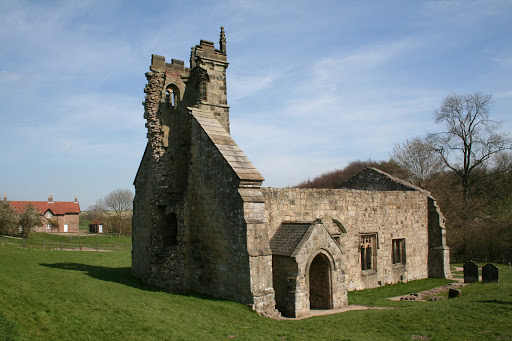
A victim of this economic change of circumstance, Wharram Percy was finally reduced to a single farmstead in the late 16th-century. All that remains of the village today are a series of earthworks, that single farmstead's 19th-century replacement (a substantial farmhouse last occupied in the 1950s) ...and the medieval parish church of St Martin...lonely, crumbling and roofless.

St. Martin's is the only building standing at Wharram Percy today that not only saw the rise and fall of the village, but recorded the population's increase and decline in its very fabric. In the outer walls of the church can be seen remnants of early 14th-century arcades, marks left by pillared aisles that were taken down as the space required to house the congregation reduced over time. Beneath the soil are the foundations of previous 10th and 11th century buildings, demolished and replaced as the village expanded into its prime.


It is quite fitting, since it tells the story of the village so well, that St. Martin's should be the only prominent reminder of the community that once resided at Wharram Percy. Up to 1870, the last of 700 members of the parish were still being buried within and without its walls.

A final service was held at the church in 1949. Since then the building has made bold statements most infrequently, its grandest protest being the collapse of it's 14th-century tower in 1959. Weather and nature are slowly muting St. Martin's tale of riches to rags...and a sad tale it is too. But though it's voice may quiet somewhat, I don't expect the church will let fifty years of neglect silence whispers that have already survived a thousand.  


This poem is also in honour of my heroes, Prof. Maurice Beresford, Economic Historian of the University of Leeds, and John Hurst, Medieval Archaeologist and English Heritage Inspector of Ancient Monuments. They spent over 40 years (1953-90), combining the expertise of historians and archaeologists to dig and research the site of Wharram Percy village; applying an interdisciplinary approach that is the only way to truly and comprehensively understand the past.  In doing so, they assisted and inspired medievalists everywhere in their studies of the DMV phenomenon...including this one!  

Wharram Percy is approached across fields, via what was once a medieval road. St. Martin's church, now a familar old friend, slowly reveals itself as you wind over the brow of a little hill. This is what passes through my mind each time I make that journey...

Upon sight of St. Martin’s Church
(standing solitary at Wharram Percy (DMV), North Yorkshire).

How now my once majestic soul?
King of your valley? Lord of your time?
You make for a sickly sight to behold
constricted and choked
by vines of ivy and bramble fruits,
surely not a fitting suit
for a gentleman such as thee?
After all the centuries that you have seen,
they dare wind among your tracery?
Embrace your pillars and strip your lead?
Drown out your candles and send you abed with soothing lies,
hiding away their vicious assault
under a beauteous guise.

How many unions of man and wife,
were fostered in your bare stones?
How many beginnings and ends of lives,
were blessed beneath the bones of these roof trusses?
How many lie beneath the grasses
that cover your long-tiled floor?
How many entered through that door,
and fell on their knees before your altar?
Yet you struggle now, in vain, to survive,
fighting
just to stay upright.

How canst thou go to dinner tonight,
my gallant, brave old Sir,
ailing and drunken, unsteady and slurred,
and without thy pocket watch?
(Cast thine eye across its face,
for it has long since stopped.)
How couldst thou stand proudly at the table’s top,
with ragged cravat,
and what was once a four-cornered hat
now crushed and reduced
to three?
How wouldst thou explain
the stolen saints
adorning every niche?

With eyes blackened
and forcibly closed,
over-run by Guelder Rose,
my good man,
you must be glad to be alone.

From riches to rags, and tired by the weather and the years...he must be glad to be alone indeed.

Monday, 5 October 2009

A Summer's Eve at Kirkstall Abbey: Sunset in the Nave

Under the banded shadow of an iron gate
That secures the chastity of sacred space
Dances through glassless windows
A macabre incubus of grandiose dust
On lengthening shafts of gilded light.
Behold! – this sudden ecstasy of lust
In the Gothic arch – a provocative sight
The eyes’ rising journey of pillar and vault
Denies the credulous fault of the expectant soul:
For there, above, a termination of scars
An insatiable majesty of stars persists
Where none but a resonant expanse of mauve exists
And a creeping rhapsody of darkness curls
From the deepening transepts of previous worlds
As finally a death of the diminutive sort,
Descends with a gasp of boundless grace
And a simultaneous expulsion of viscous light
Brings forth the rapturous crescendo of night.


I am more than lucky to live within easy walking distance of this wonderful building. Kirkstall Abbey was erected in the latter half of the 12th century, and is one of the best preserved examples of early Cistercian architecture in all of Europe. Its community of monks was disbanded in 1539, during the Dissolution, and the abbey has stood in ruins ever since. I have spent many summers here, grown up here, and drunk many bottles of wine here, on the river bank, with wonderful people. I think this building got into my soul at a very early age and I ought to credit Kirkstall with inspiring a large portion of my interest in all things medieval.