Showing posts with label history. Show all posts
Showing posts with label history. Show all posts
Monday, 28 January 2019
The Passion
Here's a long story,
a glorious rapture descending -
vines creeping, into veins and blood,
foliate bosses and hood-moulds
crenellating,
the doors to Narnia's portal. They left my finger
hopelessly trailing,
over,
time
immortal. The long shadow of a broken sceptre,
ground beneath:
the bone collector, shaft of dust,
through long windows thrown
lighting wildflowers impossibly grown from the
ruins of matins,
prime and nones,
a mystery extant speaks of all
that is gone in the wind,
the rain:
in the unholy fires,
the crashing down of celestories and
spires, and I wandered amongst them; their gritty texture,
whispering of lauds,
compline and vespers, a scratch in
the buttress, striking the time: eyes to heaven and glitter
falls down my spine, still, and the doves that call,
from the remnant of a crossing,
emboss my heart and spread wings in my chest -
where once the vestments
were plain,
I see a myriad of colours overlain:
as a pale hand in a silken glove.
And it was here, I recall, my head began to spin with it.
It was here
I fell
in love.

Monday, 1 February 2016
Forgotten
There was thick
mud that day
as I slid, and slipped
my way, along the steep ravine to you;
as I did the things
that were asked of me,
that, right then, I did not want to do.
I looked upon the bottom
of a tree, roots entangled; an evergreen; a place that had always been to me,
a spot called clear to mind;
the place your dust rested,
in the shape of a cross,
in a year gone far behind.
I laid the roses
I didn’t want
to lay; and I said words I had not
prepared to say,
and I kissed my fingers in a dutiful way, and
pressed them
to the freezing ground. And then I turned around,
and climbed the sticky hill, shaking legs and an iron
will, not a tear nor a trace
would show.
And I walked away, triumphant; ready to go,
when a voice called out: ‘Not there…no.’
And it went on: ‘That’s not the place.
No, the ashes were never
spread that way. That wasn’t what they had to say…
you recall it all so
wrong.’ And I tried to remember; even just which
song, was played the first
and last – and all I could hear
was the shattering of glass, as I realised each effort
drew a blank,
from the darkest corner of my mind.
I had no memories of any kind; it seemed all I’d known
were self-told lies, and today I cannot even find, the truth
about the colour
of the box
we laid you in.
But I think I remember
what you were wearing.
And I see lilies
and roses
when I close my eyes;
on the nights when I am lucky enough,
not to see
the moments
before you died. I remember those
the best.
I’m sorry…
I didn’t mean to.
I seem to have forgotten the rest.
Tuesday, 31 December 2013
What's In a Name?
My mother told me a story, many times, when I was small. A story about the moment of my birth, and the year thereafter. This is her story, a story she can no longer tell herself, in all the words that I remember:
"Three strong pains..." mum would always say. "Three strong pains, and you were born. They said you couldn't be coming that fast, but I told them - they were wrong! No time to go to the ward! Get me in that delivery suite, this baby isn't prepared to wait!" It was 1am, September 1984. Thursday's child has far to go...
"You were a month early" she'd say, "you were born tiny, but totally perfect. Six pounds, seven ounces, and nineteen inches long - skinny, like a little rabbit! And so much hair! You were totally clean when you were born; like you'd just had a bath. And you had this pet lip - like a spoiled little madam! We had a name picked out already - you were going to be 'Jessica' - 'God's Grace' or maybe, 'One who sees', dependant on which baby-name book you checked! 'Jessica Amy' - Amy had been my grandmother's name, but you weren't really named after her - we just liked it, your father and I. It's French, it means 'love' or 'beloved one'. Put the names together and they had a certain ring to them; and we had our little girl - 'One who sees love', or perhaps 'God's Graceful Love' I didn't mind which it meant. Both were beautiful and virtues I wanted you to carry. We didn't know what we were having, I didn't know you'd be a girl, but I wanted one! Secretly! I got what I wanted."
"I was an older mum, so I'd had this new test, to take fluid from around the baby and see that everything was alright. We could have lost you having the test, but I wanted to know you were healthy, since I was older. They could have told us what we were having from that. I was tempted to find out, but your dad said 'no'. He wanted a surprise, and I didn't really mind waiting."
"The first person to hold you when you were born was your father, and as he handed you to me, the midwife was filling out the little bracelet that they put around your baby's leg, and she said, across the room: 'What's your daughter's name?'"
"Well, I was just looking at you thinking you looked so much like your dad, and then I heard him say: 'Amy', and I looked up and asked: 'What happened to Jessica?' 'Amy Jessica', he said, 'I can't stand the thought of her being 'Jess' or 'Jessie'. 'Amy Jessica' it was - and so the Love came first and the Grace second, and it was fitting really, because you were not so graceful for a very long time, I can tell you!"
"I asked your dad then, just after you were born, if he was disappointed that you weren't a boy. I was 38 years old, I didn't want more children. You'd been your father's idea really, he said it wasn't fair to have an only child. Your sister should have a playmate. We had a daughter already, and I thought he might have wanted a son."
"He looked at me and said: 'How could I ever be disappointed? ...just look at her.' And that was that - family complete. We had two little girls."
"When we brought you home, a sister for Zoe Leanne, she ripped the blankets off your carrycot right away, and said: 'Come on then, let's have a proper look at you!' She adored you, of course, and you had visitors cooing over you constantly, and were peaceful, sleepy and gorgeous - you were just like any normal baby for six weeks..."
"Then all of a sudden, you started to cry...and, oh my goodness, you wouldn't stop crying. Suddenly, you didn't sleep anymore, you couldn't keep anything down. You were like one of those baby-dolls that wails every time you lay it flat and throws up every time you sit it up! I had to cover everything in plastic to feed you because you were certain to bring it all back. I'd sit you up, and you'd give me this beautiful smile, and then a projectile milk-stream would come firing out of you! It was like something out of The Exorcist! We were so worried about you! We'd never seen anything like it! We took you to doctors, and then hospitals, who all said the same thing: you had terrible colic. Appalling reflux and cramps. And there was nothing we or they could do - you'd just grow out of it in a few weeks. But you didn't...months passed, and it carried on. You seemed to be in so much pain, I asked the doctors, wouldn't you remember this? Wouldn't you be traumatised by hurting so much?"
"They said you'd never know, but still, we tried everything to soothe you - and nothing worked. I was at home with you all day; sometimes I just had to put you down in your cot and let you cry. I had to walk away before I got so frustrated that I couldn't keep control. I would go sit on the bottom step and cry with you, because I knew you were screaming in pain, screaming for me who was supposed to make it better, and there was nothing I could do to help you. The way that pulls at a mother's heart... How useless you feel. I'll never forget it."
"Your sister was only three, but she tried to help me. She would say: 'Prop her up on the floor cushion mummy, and I'll play with her', when she knew I needed a break. Your second little 'mum' from day one. When I cried she would wipe my tears and say: 'Mummy, please don't cry.' Your dad worked long shifts, but every night when he walked through the door, I would take you off my shoulder - the only place you were comfortable - and pass you on to his. You spent 12hrs a night on his shoulder for two years - he daren't sit down with you in case he fell asleep and hurt you, so he walked. Up and down the living room, all night long to let you rest. You'd sleep right through the night, like any other baby, as long as you could be upright. I look back now, and I don't know how he did it. Working like that on no sleep. He never complained - there's no love close to that in the world."
"I went back to work when you were nine months old. Honestly, I needed to get out of the house. I needed to get away for a few hours a day. Your sister had been an angelic baby - we didn't know what had hit us with you. By that time, you'd spent so long in a door bouncer, keeping upright, that your legs were the strongest part of you, and you were walking! At nine months! My clever girl! I remember, I was changing the bed one day and I'd left you in your bedroom with some toys, and you just walked in! It looked hilarious - you were so tiny to be walking, but there you were, rock steady! Curly blonde hair, pink dungarees, and your chubby little fingers stuffed in your mouth, making a cheeky face at me! I scooped you up and clapped and Zoe and I kissed you and tickled you all over saying: 'Who's a clever girl? Who's so clever?! And everything that was such hard work about you, melted away in moments like that. Melted when you laughed, melted when you smiled, and most of all...when you loved. You melted people with all that cheeky charm!"
"Your sister had been a baby who wanted cuddles when she was happy to receive them, she had to come to you for them, and she'd wriggle and squirm if she wasn't in the mood! Not you. You gave out cuddles whenever another asked for them, and when they didn't! It didn't matter what you were doing - 'Amy - come and kiss your nanna...' 'Amy, give mummy/daddy a cuddle...' 'Hold my hand...sit on my knee', you were so affectionate we had to watch you with strangers. You would sit on anyone's knee, talk to anyone. So many times I turned around in a supermarket and you were gone - heart in my mouth, I'd find you sat on a bench talking to some old man or something. Handing out some of that foresight and grace you were starting to grow into. So friendly, so sociable...and so full of mischief! You were wilful to the point of driving me to distraction! Frequently downright naughty! I had to tie the legs of the dining room chairs together so you couldn't pull them out, because you climbed everything! I knew we were biased, but we'd honestly never known anyone like you! Neither had most people who met you!"
"By the time you were a year old, you could hold a full scale conversation, and were more than capable of expressing an opinion! You told a man in a swimming pool once, that he looked just like a monkey. The poor man was covered in dark hair all over his chest, back and arms and you laughed at top volume, pointed, and just spoke your mind! I wanted the water to swallow you up! You looked over your daddy's shoulder one day, whilst he was scolding you for something or other, leaned your chin in your hand and said: 'It's a lovely day, isn't it?', just trying to change the subject! And you got away with it! You've got to appreciate how funny this stuff sounded, coming from a fourteen month old child! And how adorable it was."
"You made friends everywhere. On holiday when you were eighteen months old, you wandered off on an Italian beach, sat on the end of a man's sun lounger, and proceeded to lecture him about what a dirty habit it was to smoke his cigarettes and stub them out in the beach sand! He wasn't cross, he didn't think you were rude...he was enchanted. They pitched next to us for a week, just to see what else you'd say! You even started speaking Italian to the maids who cleaned the hotel room - language barrier? What language barrier?"
"Yes, I always thought we'd named our baby well. For love...and grace...and the blessing of being able to make people see only those things, even when you were being as 'honest' or as mischievous as only you could get away with! However much hard work you were, you were certainly worth it."
For the heroes that were my mum and dad in those first two years. It must have been Hell, guys. You were truly superhuman. There is no greater love than that which puts another first - and no more moving story, for me, than my own creation, in my mother's own words. To hear something so unconditional, over and over as a child, means it will live with me forever, and despite whatever the future may have held, it was never wholly lost - because I remembered. Thank you for knowing the meaning of love - I really hope I gave everything back. xxx
 |
| Hours old, meeting my 'second mum', my big sister, Zoe. |
 |
| 19mths - in the park with daddy. |
 |
| 9mths - celebrating having just walked for the first time, with Zoe. |
 |
| 12mths - generously sharing my first ice-cream with my mum! |
 |
| 18mths - digging forbidden holes in an Italian beach with Zoe & dad. |
Friday, 4 January 2013
Wet Dawn Over Coniston
A thousand panes and a hundred
eyes; challenge swirling mist and the
morning’s, grey sky, the water’s edge is a
precipice denied, and he teeters,
to tease of old times.
Stretching columns,
like a temple of sorts, belch out fresh spirits
that seem
to purport to the hills, and the mountainous
terrain, that he has withstood
far heavier rains than these sapphires,
that tumble and roll; worse gales than
this bluster that mal-forms and
folds all the trees, like green match-sticks
or grain,
as a forest slides on clouds
to meet him again.
Slowly, and with effort,
he creeks to his feet;
polite old gent who still stands
to greet and shake hands with his welcome guests;
shoes shone and tie on,
in his Sunday, church-best; the thousand eyes glint
and his pipes puff to test, if he still
can blow smoke rings
to delight all those present.
The ghost of a moon
forms a small-smiling crescent; overhead;
as he nods, and tilts his slate cap –
still as defiant and cheeky old chap, despite all his
crumbling walls…
The lake-fog rolls over to blanket his armchair.
Be seated –
I will walk to you,
weary Coniston Hall.
weary Coniston Hall.
Sunday, 20 June 2010
Rievaulx
Good day, old friend, it's been
some time,but like one
gone
almost blind, I feel I am home;
for your stones have owned, moments,
of my
prolific life
without question or promise
of warm
safe nights or moral comfort...
your walls
had eyes.
You remind me now
as I sit on your carvings
of basest cravings long fulfilled;
you recall heaven
spilled in sunshine, on stone,and things and hands long since cast from
my bones, and as I
trace my fingers on your
crumbling face
my own reddens for a lack
of restraint, in what was once,
holy space,
and I lick my lips and mouth
that nameand remember how we sullied
your tunneled drains.
Our backs to your sand, as the
swallows
flew over,
surrounded by moss and daisies
and clover, with filthy water
at our feet...
I see,
only now,
- the first time I have been here since -
that as beautifulas we thought
our act of defiance,
and freedom,
to be,
our supposed, sublime serenity
(and imposition)
was nothing here -
for it could not compete
with thee.
Written on a Leeds Savage Club Sketchers' Excursion to the stunning ruins of Rievaulx Abbey, North Yorkshire...
Sunday, 9 May 2010
The Farmer’s Boy
Inspired by tales of my dad's early childhood with his sister, on a Lincolnshire farm worked by their father and uncle. As a boy, my dad believed he would probably inherit the farm, but dreamed of broader horizons & someday living in the 'big house' instead!
You drove me insane,
you know?
Like twisted poles
on a carousel,
at a neighbouring county fair. And every time
I requested horizons
you were upright,
and standing there, in the road,
like a scarecrow,
with his arms
wavering in the breeze – you were ragged,
and always ready to leave, just as soon
as you had come.
And I remember the horses
in the fields were dun, and red
as apples in the setting suns
of nether-worlds we’d never see.
And we skipped across the golden barley
like flat stones
on surface water,
ever a contented son and daughter, of trees,
and of the cross-beams
that stretched along the barn.
And there was nothing like summer
sun farmed,
for best butter and cakes in the pantry,
and a dozen heifer-calves
raised by an aunty in the crew-yard
out the back; an uncle who slept on potato sacks,
on the steps of the tractor shed;
and a tilly-lamp lighting
our way to bed to dream of more wonderful days,
when we’d look to the big,
house on the hill,
for the will to grow
up and be,
lord and lady of all we surveyed.
My father's sister, Vivienne Maxine Taylor, was killed in a farming accident, aged 9. This poem is dedicated to her memory.
Needless to say, the farm was sold. My father never did inherit...nor does he live in the 'big house'!
Thursday, 18 February 2010
'The Sight'
I could see souls,
you said, and I know
that scared you
half to death
for fear that I’d
see yours.
But you gave me cause to look
anyway,
didn’t you?
You wanted me to see through
your damage
and your lies –
you had something like
snake eyes, and they
looked daggers at me;
the doomed king (or queen)
to your Macbeth.
And you may call me damned
or blessed,
but I’d have hurled myself
from the tower for truth,
and it was clear how you knew that,
for there’d be no one there to catch me
when I fell.
I may as well have turned my soul
and all those seen,
over to the fires of Hell
and testified
to their lonely burning,
for only one thing is certain –
it wasn’t ‘the sight’ that left me yearning for
the rotten fruits of vile temptation,
for justice, love, and my own salvation –
No. You need not fear at all;
this queen never saw your soul –
just the choking blackness of
the hole
where once it should have been.
Been re-reading Macbeth this week, can you tell?! :-)
Monday, 15 February 2010
Medieval Architecture in my Glorious County - St. Hilda's Curves...
This is St. Hilda's, in Whitby, North Yorkshire.

First founded in 657AD, this glorious Benedictine abbey was the venue for King Oswiu of Northumbria's 7th century 'Synod of Whitby', wherein it was decided that the Northumbrian church would adopt the Roman Catholic calculation of Easter and monastic tonsure (the traditional monks' haircut!). It was also home to the Saxon poet, Caedmon.
The abbey was re-founded in 1078 on the orders of William de Percy, and re-dedicated to St. Peter and St. Hilda. It survived until 1540, when it was finally sacked during the Dissolution.
The ruin has since been a landmark for many a sailor, and an inspiration to many a writer, including Bram Stoker in the process of writing, Dracula. I follow in their esteemed footsteps with a poem about my love of medieval architecture, and the compulsion to draw features and plans of St. Hilda's Abbey -
Drawing St. Hilda (Whitby, N.Yorks.)
I want to talk of curves and lines,
of willow trees, and creeping vines
and beautiful decay, I want to talk
of summer days spent
beneath your shade,
to vanquish all who seek to
take an ounce
of majesty from you.
O the things I want to do –
To touch you
And draw you
and coat you and call you
in dreams of sandstone and ice cream,
to hear you scream my name
back through time
in centuries infinitely more sublime than
this I dare call mine. I want to talk of
curves and lines –
Oh yes, and better still,
I want to caress them long and
Lithe,
Arched and true;
I want you – for as long as you’ll
have me, abbey, for as long
as you’ll let me
sit and copy
every swoosh and circle,
every rose and purple wildflower –
I want to taste you
for hours – to wrap my
fingers round pillars and butts
and cover you in the gelatinous
lustre of grace. I want to leave
it on your face, forever, – so you
stink of me, and I of you,
so we will be like the glued pigeon
feathers that cling to your hair and edges –
both of us soft and solid wretches,
unwillingly pledging
to be together until we are free.
Sunday, 14 February 2010
Life On A Postcard...
Where inspiration's concerned, I'm in a bit of a Biblical phase at the moment! I think this has a lot to do with the fact that I've been re-reading Mary Shelley's Frankenstein lately and have rediscovered and been affected by all the previous texts, themes of good and evil, and the Biblical gender portrayals and ideals that affected its Victorian author.
As a result, when I was asked last week, as a task for the Leeds Writers' Group, to compose a 'life on a postcard', the following poem is what I came up with. In my Biblically-influenced state, I decided this little 'biography' ought to be a comment on the development (or lack of development!) of the character of 'woman' in the first four books of the Old Testament:
The Life of a Woman
(From Genesis to Deuteronomy)
See here, woman, how thou art unclean
of flesh, and all living wickedness art in thee,
but still, see, how thou art loved the same
and made as one with man,
made from him, no less,
born of earth and rib in Genesis,
as daughters have rights of sons.
See how thou art done well, by an honourable
God, despite thy vileness and thy sin?
See how thou didst begin in all deceit and gore?
See also how the mighty law protects thee
and defiles thee,
see how thou art free and guided
into chains. For thou shalt not kill, woman,
but thou shall be maimed
for thy whoring, and thy adultery…
…lest, of course,
thou be guilty…or be not.
And no sons wilst thou have begot
‘less in pain and misery, for thou deservest,
as the one who yeildeth first unto the serpent, and led men astray -
thus shalt thou crawl ever as he,
upon thy belly all your days.
And men shall be as angels yet, in My image,
to rule upon you for all’s sake.
Wednesday, 6 January 2010
The Whispers of Valour
The whispers came when you slept,
but they were whispers only
to you.
For me
(and our neighbours)
they were
moments of truth outside
your armoured charade.
The only instants in which you
faced
the demons you'd brought home.
And I blamed you for their presence,
you know
in my moments of love
and the days of storms;
for your nights
beating out
those visions of torment,
until we could
no longer prevent
what was coming.
We never spoke of it;
you and I;
instead we smiled, politely,
and made small talk
in a railway carriage
on a day when the sky
had never been
so blue
and we could not
deny
that to discuss the weather
was just as pleasant
as ever it had been before.
It was a meeting of minds;
a decision,
but not of hearts anymore.
Those we closed the door upon,
(like your screaming)
until it was over.
I wouldn't miss you,
and you wouldn't write,
you'd face each loud, infernal night,
all bombs and fire-fights,
without me
to cling to
and you'd be brave
And I would close my eyes
and crave
the man I used to know
as I listened alone
to the wheels on the tracks
having sent you back
to the viper's nest
that stung you,
stole you,
and spawned your horror.
And this, my love,
is what you and I,
would come to know,
as 'valour'.
Dedicated to all who love, or have loved, a soldier.
but they were whispers only
to you.
For me
(and our neighbours)
they were
moments of truth outside
your armoured charade.
The only instants in which you
faced
the demons you'd brought home.
And I blamed you for their presence,
you know
in my moments of love
and the days of storms;
for your nights
beating out
those visions of torment,
until we could
no longer prevent
what was coming.
We never spoke of it;
you and I;
instead we smiled, politely,
and made small talk
in a railway carriage
on a day when the sky
had never been
so blue
and we could not
deny
that to discuss the weather
was just as pleasant
as ever it had been before.
It was a meeting of minds;
a decision,
but not of hearts anymore.
Those we closed the door upon,
(like your screaming)
until it was over.
I wouldn't miss you,
and you wouldn't write,
you'd face each loud, infernal night,
all bombs and fire-fights,
without me
to cling to
and you'd be brave
And I would close my eyes
and crave
the man I used to know
as I listened alone
to the wheels on the tracks
having sent you back
to the viper's nest
that stung you,
stole you,
and spawned your horror.
And this, my love,
is what you and I,
would come to know,
as 'valour'.
Dedicated to all who love, or have loved, a soldier.
Wednesday, 2 December 2009
Nothing Important Happened Today
Below is my offering for the exercise leading up to this week's meeting of the Leeds Writers' Group. The set task was to write a character interaction without using dialogue...or any other form of speech. The characters could not make a sound, yet the audience must understand what has happened.
I decided to use the following poem as my exemplar, but wondered if writing one character's thought process as an unspoken monologue might just be cheating a little?! I concluded it probably was, but then, I didn't really care...because I wanted to write this piece!
The Inspiration
On 4th July 1776, King George III added one line to his personal diary. That line read: 'Nothing important happened today.' This has since been quoted by many historians, novelists and screen writers, in order to illustrate how 'out of touch' the king must have been with current affairs...The 4th July 1776 was, after all, the day that the US Declaration of Independence was signed.
However, it occurred to me that King George III had not, as is often thought, failed to notice the events of that day. He had simply decided to find them unimportant... Or he had not yet received word of the development. Either way, it didn't really matter... at that stage of the American Revolution, there was little King George could do to influence its outcome... As far as he was concerned, nothing had changed that day...nothing important anyway...
The Poem
Here is my interpretation of King George III's famous diary entry; and of something akin to the helpless situation he must have found himself in when he wrote it:
Nothing Important Happened Today
I have nothing important to say.
Though I've plenty of words.
You see, I can say nothing to stop what's coming;
To halt the drowning,
Keep us running, and so,
I've nothing important to say.
You're not listening anyway,
Not really.
You're unimportantly packing a box
With CDs and socks and teacups
And no words could make you stop
So I've nothing important to say.
You're at the door now,
You...and the box...
And you don't look back.
You pause, and breathe,
But you don't stop.
You don't turn back and fix it with kisses
Or smiling, promise by tomorrow to miss me
And come home.
So there's nothing important to say.
The door closes behind you.
Nothing important happened today.
I decided to use the following poem as my exemplar, but wondered if writing one character's thought process as an unspoken monologue might just be cheating a little?! I concluded it probably was, but then, I didn't really care...because I wanted to write this piece!
The Inspiration
On 4th July 1776, King George III added one line to his personal diary. That line read: 'Nothing important happened today.' This has since been quoted by many historians, novelists and screen writers, in order to illustrate how 'out of touch' the king must have been with current affairs...The 4th July 1776 was, after all, the day that the US Declaration of Independence was signed.
However, it occurred to me that King George III had not, as is often thought, failed to notice the events of that day. He had simply decided to find them unimportant... Or he had not yet received word of the development. Either way, it didn't really matter... at that stage of the American Revolution, there was little King George could do to influence its outcome... As far as he was concerned, nothing had changed that day...nothing important anyway...
The Poem
Here is my interpretation of King George III's famous diary entry; and of something akin to the helpless situation he must have found himself in when he wrote it:
Nothing Important Happened Today
I have nothing important to say.
Though I've plenty of words.
You see, I can say nothing to stop what's coming;
To halt the drowning,
Keep us running, and so,
I've nothing important to say.
You're not listening anyway,
Not really.
You're unimportantly packing a box
With CDs and socks and teacups
And no words could make you stop
So I've nothing important to say.
You're at the door now,
You...and the box...
And you don't look back.
You pause, and breathe,
But you don't stop.
You don't turn back and fix it with kisses
Or smiling, promise by tomorrow to miss me
And come home.
So there's nothing important to say.
The door closes behind you.
Nothing important happened today.
Wednesday, 11 November 2009
Wharram Percy (DMV) & St. Martin's Parish Church
There follows a poem, written in honour of one of my favourite archaeological sites, the deserted medieval village of Wharram Percy, in North Yorkshire...but first, a little history lesson...

The settlement of Wharram Percy (mentioned in the Domesday Survey and taking its name from its manorial lords, the noble Percy family) reached the peak of its occupation in the early 14th-century. Due to the economic impact of the Black Death of 1349, later that century the village began slowly shrinking as newly-free peasant families migrated in search of higher wages.
A lack of labour after high death rates meant power had shifted to the workers and a competitive wage market forced land owners to find ways of making profits with fewer employees. Sheep rearing required less manpower and thus, quickly replaced vast swaithes of previously arable farming in the Yorkshire Dales. Starting a vicious cycle, the sheep made employment scare. This meant workers continued to migrate, even after the population recovered from the Black Death's impact...and the sheep required grazing, resulting in vacant houses being swept away.
A lack of labour after high death rates meant power had shifted to the workers and a competitive wage market forced land owners to find ways of making profits with fewer employees. Sheep rearing required less manpower and thus, quickly replaced vast swaithes of previously arable farming in the Yorkshire Dales. Starting a vicious cycle, the sheep made employment scare. This meant workers continued to migrate, even after the population recovered from the Black Death's impact...and the sheep required grazing, resulting in vacant houses being swept away.
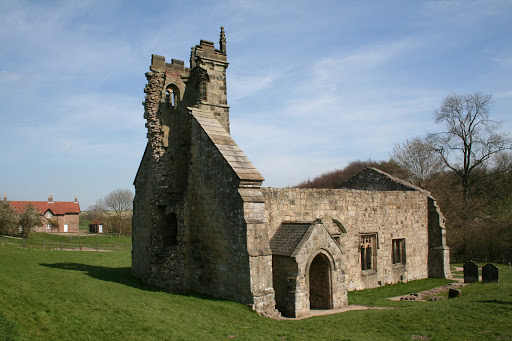
A victim of this economic change of circumstance, Wharram Percy was finally reduced to a single farmstead in the late 16th-century. All that remains of the village today are a series of earthworks, that single farmstead's 19th-century replacement (a substantial farmhouse last occupied in the 1950s) ...and the medieval parish church of St Martin...lonely, crumbling and roofless.
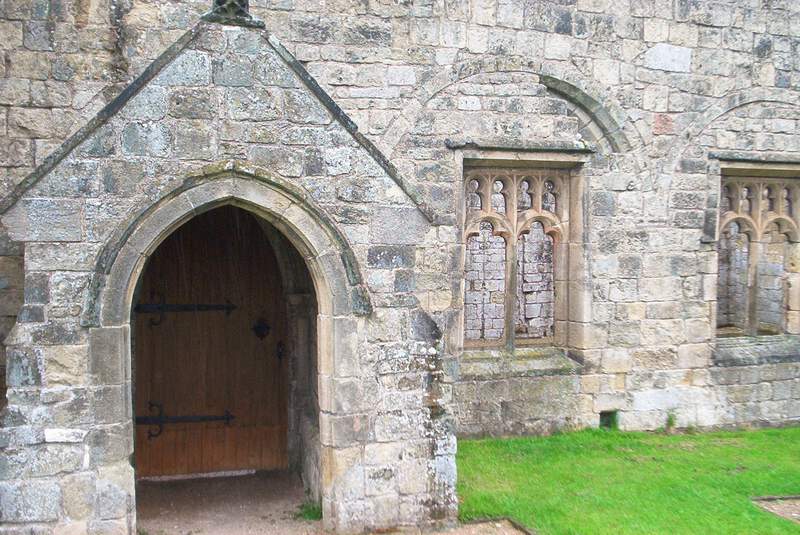
St. Martin's is the only building standing at Wharram Percy today that not only saw the rise and fall of the village, but recorded the population's increase and decline in its very fabric. In the outer walls of the church can be seen remnants of early 14th-century arcades, marks left by pillared aisles that were taken down as the space required to house the congregation reduced over time. Beneath the soil are the foundations of previous 10th and 11th century buildings, demolished and replaced as the village expanded into its prime.

It is quite fitting, since it tells the story of the village so well, that St. Martin's should be the only prominent reminder of the community that once resided at Wharram Percy. Up to 1870, the last of 700 members of the parish were still being buried within and without its walls.
A final service was held at the church in 1949. Since then the building has made bold statements most infrequently, its grandest protest being the collapse of it's 14th-century tower in 1959. Weather and nature are slowly muting St. Martin's tale of riches to rags...and a sad tale it is too. But though it's voice may quiet somewhat, I don't expect the church will let fifty years of neglect silence whispers that have already survived a thousand.
A final service was held at the church in 1949. Since then the building has made bold statements most infrequently, its grandest protest being the collapse of it's 14th-century tower in 1959. Weather and nature are slowly muting St. Martin's tale of riches to rags...and a sad tale it is too. But though it's voice may quiet somewhat, I don't expect the church will let fifty years of neglect silence whispers that have already survived a thousand.
This poem is also in honour of my heroes, Prof. Maurice Beresford, Economic Historian of the University of Leeds, and John Hurst, Medieval Archaeologist and English Heritage Inspector of Ancient Monuments. They spent over 40 years (1953-90), combining the expertise of historians and archaeologists to dig and research the site of Wharram Percy village; applying an interdisciplinary approach that is the only way to truly and comprehensively understand the past. In doing so, they assisted and inspired medievalists everywhere in their studies of the DMV phenomenon...including this one!
Wharram Percy is approached across fields, via what was once a medieval road. St. Martin's church, now a familar old friend, slowly reveals itself as you wind over the brow of a little hill. This is what passes through my mind each time I make that journey...
(standing solitary at Wharram Percy (DMV), North Yorkshire).
How now my once majestic soul?
King of your valley? Lord of your time?
You make for a sickly sight to behold
constricted and choked
by vines of ivy and bramble fruits,
surely not a fitting suit
for a gentleman such as thee?
After all the centuries that you have seen,
they dare wind among your tracery?
Embrace your pillars and strip your lead?
Drown out your candles and send you abed with soothing lies,
hiding away their vicious assault
under a beauteous guise.
How many unions of man and wife,
were fostered in your bare stones?
How many beginnings and ends of lives,
were blessed beneath the bones of these roof trusses?
How many lie beneath the grasses
that cover your long-tiled floor?
How many entered through that door,
and fell on their knees before your altar?
Yet you struggle now, in vain, to survive,
fighting
just to stay upright.
How canst thou go to dinner tonight,
my gallant, brave old Sir,
ailing and drunken, unsteady and slurred,
and without thy pocket watch?
(Cast thine eye across its face,
for it has long since stopped.)
How couldst thou stand proudly at the table’s top,
with ragged cravat,
and what was once a four-cornered hat
now crushed and reduced
to three?
How wouldst thou explain
the stolen saints
adorning every niche?
With eyes blackened
and forcibly closed,
over-run by Guelder Rose,
my good man,
you must be glad to be alone.
From riches to rags, and tired by the weather and the years...he must be glad to be alone indeed.
Friday, 16 October 2009
'The Letters of Abelard and Heloise'...the poetic influence of an 11th-century narcissist?
I've threatened before to start adding other things that interest me to this blog, aside from my resultant poetry, as I think it might start to explain some of my influences and inspirations (to myself as well as anyone else who decides this is worth a read!). I'm aware that a lot of what I write stems from things I've seen, done, studied or read; that a lot of it relates to experience. However, having said that, much of what I've read, studied, and continue to read on a poetic level, is late medieval or early modern, with the occassional dip into the 19th-century. I love Mallory, Chaucer and Donne, Shakespeare, Marlow and Rossetti, so it seems strange even to me, that I should begin an insight into my poetic psyche with a post about Peter Abelard and Heloise!
For those as yet unfamiliar with Abelard (you have no idea what gems of hilarity you've been missing in his autobiography!), he was born in 1079, in the village of Pallet, in Brittany. His father being a manorial lord and minor noble, Abelard, as eldest son, was intended for a career in knighthood. However, as a boy, he found book learning favourable to the lure of violent conflict, just killing, honour, and chivalry:
'I prefered the weapons of dialectic to all the other teachings of philosphy, and armed with these I chose the conflicts on disputation instead of the trophies of war...'
(Thought a translation might be appreciated rather than the original medieval Latin! - The letters of Abelard and Heloise, Peter Abelard, Héloïse, Betty Radice, M. T. Clanchy, 2003.)
When a little older, Abelard became a wandering scholar, which during this period, also made you a monk of sorts, as all scholarly persuits and teaching were theological in nature and under church control. Abelard spent some time at Locmenach before heading to the Cathedral School of Notre Dame, Paris, where he promptly decided (on somewhat shaky grounds!) that his intellect and powers of theological interpretation were far superior to that of his peers and teachers. As a result, he resolved to set up his own school in Melun, around 1101, where he royally irritated his contemporaries with a condescending attitude and a fondness for being right!.
Abelard returned to Paris in 1113, becoming a teacher there. Yet he was clearly not cut out for a life of piety! He began a torrid and forbidden affair with the niece of Canon Fulbert; the apparently beautiful and alluring young abbess, Heloise. The pair fell madly in love, and exchanged various amorous, pained and guilt-ridden letters describing their passions, admirations, separations and inability to resist their basest temptations. Various trysts ensued in the abbeys and convents of Europe, eventually resulting in a son and a secret marriage...all prior to the complications of vengeful castration and accusations of heresy!

The Letters of Abelard and Heloise (as should by now be obvious to even the most previously ignorant reader!) are neither late medieval to early modern or, largely poetic. However, they do, in much the same manner as Shakespeare's sonnets and tragedies or Mallory's tales of knighthood in Morte d'Arthur, tell a vivid and engaging tale of gripping desire, an impassioned and destructive affair, and the conflict between duty and love, providing a peek at the results of unchecked human emotion and weakness that is as relevant today as ever. The letters are also soaked with that over-blown and fervent language of high medieval piety, devotion, love, sorrow and guilt that fires the artist in me!
'God knows I never sought anything in you except yourself. I wanted simply you, nothing of yours.'
'I desired to keep you whom I loved beyond measure for myself alone.'
So, after having more free time this week than usual to over-indulge in all things artistic, and finding myself once again retrieving The Letters of Abelard and Heloise from a dusty shelf in the spare bedroom to thumb its well-worn pages, I think I must face the truth. I frequently write in a style very similar to that of Abelard and Heloise, utilising themes of guilt, passion, love, pain, Heaven, Hell, damnation, and futility...and I'm fascinated by the ever-surprising strengths, weaknesses, and inexplicable, unavoidable agonies of people. Somewhere along the line, Abelard and Heloise have influenced my writing.
'How can it be called repentance for sins, however great the mortification of the flesh, if the mind still retains the will to sin and is on fire with its old desires?'
The man himself, I'm certain, would have rebuffed this 'mighty revealation' with a sniffy "but of course," ...and thus, I must also admit to myself, that my inspirer was a self-indulgent narcissist, who enjoyed pedalling his own intellect and creativity for gains of fame and admiration (who me?!). However, he, and his lover Heloise, were also passionate human beings, great forward thinkers not afraid to speak their minds, and above all else, engaging writers that keep me taking that book down from its dusty shelf over and over again...so in this context, Abelard (and Heloise), my self-appreciating friend(s), I'm more than grateful for your contribution to my muse!
Monday, 5 October 2009
A Summer's Eve at Kirkstall Abbey: Sunset in the Nave
Under the banded shadow of an iron gate
That secures the chastity of sacred space
Dances through glassless windows
A macabre incubus of grandiose dust
On lengthening shafts of gilded light.
Behold! – this sudden ecstasy of lust
In the Gothic arch – a provocative sight
The eyes’ rising journey of pillar and vault
Denies the credulous fault of the expectant soul:
For there, above, a termination of scars
An insatiable majesty of stars persists
Where none but a resonant expanse of mauve exists
And a creeping rhapsody of darkness curls
From the deepening transepts of previous worlds
As finally a death of the diminutive sort,
Descends with a gasp of boundless grace
And a simultaneous expulsion of viscous light
Brings forth the rapturous crescendo of night.

That secures the chastity of sacred space
Dances through glassless windows
A macabre incubus of grandiose dust
On lengthening shafts of gilded light.
Behold! – this sudden ecstasy of lust
In the Gothic arch – a provocative sight
The eyes’ rising journey of pillar and vault
Denies the credulous fault of the expectant soul:
For there, above, a termination of scars
An insatiable majesty of stars persists
Where none but a resonant expanse of mauve exists
And a creeping rhapsody of darkness curls
From the deepening transepts of previous worlds
As finally a death of the diminutive sort,
Descends with a gasp of boundless grace
And a simultaneous expulsion of viscous light
Brings forth the rapturous crescendo of night.
I am more than lucky to live within easy walking distance of this wonderful building. Kirkstall Abbey was erected in the latter half of the 12th century, and is one of the best preserved examples of early Cistercian architecture in all of Europe. Its community of monks was disbanded in 1539, during the Dissolution, and the abbey has stood in ruins ever since. I have spent many summers here, grown up here, and drunk many bottles of wine here, on the river bank, with wonderful people. I think this building got into my soul at a very early age and I ought to credit Kirkstall with inspiring a large portion of my interest in all things medieval.
Subscribe to:
Posts (Atom)